
Mozart's Forgotten Student
A newly identified manuscript from 1778 Paris reopens the question of what Mozart thought teaching was for

Discovery of a Previously Unknown Mozart Autograph Manuscript in the Music Department of the Bibliothèque nationale de France
To be broadcast on France Musique, 22 June
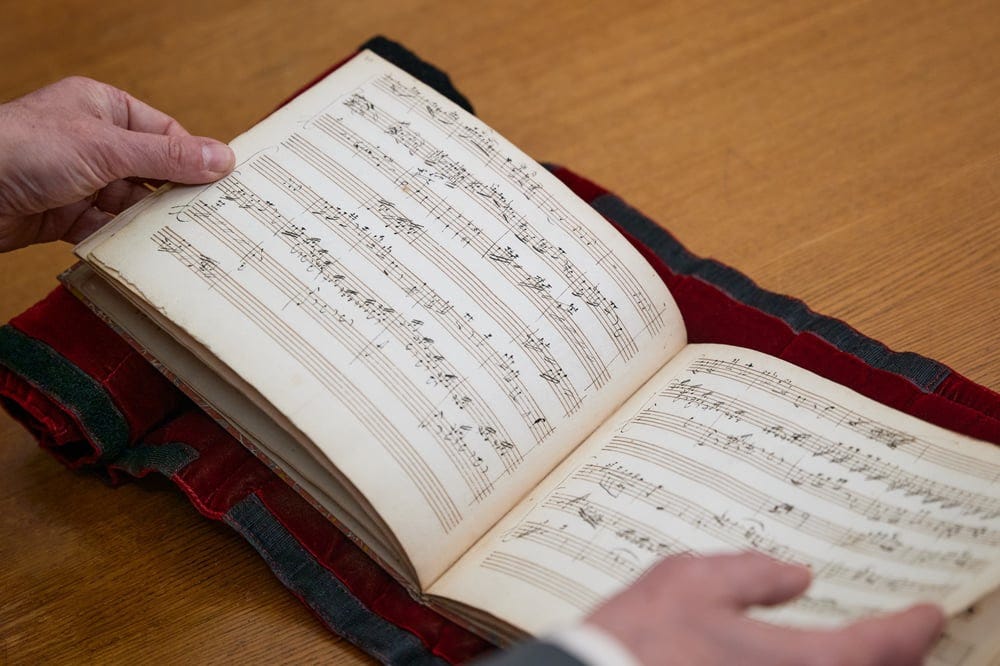
The Bibliothèque nationale de France (BnF) has identified a previously unknown manuscript by Wolfgang Amadeus Mozart, composed during his 1778 stay in Paris. The document takes the form of a forty-four-page notebook containing composition lessons given to Marie-Louise-Philippine de Bonnières de Guînes (1759–1795), an accomplished harpist and daughter of the Duke de Guînes. Located in February 2026 in the BnF’s Music Department, the notebook constitutes a valuable source for understanding Mozart’s pedagogical methods.
Gilles Pécout, President of the BnF, characterized the find as among the most significant of recent decades, noting its dual importance: it documents Mozart’s final stay in Paris and reveals the daily activity of the young composer as teacher, in dialogue with his student. He observed that the BnF’s Music Department, owing to gifts and acquisitions, has become the second-largest repository of Mozart manuscripts after Salzbourg, and expressed hope that the discovery would encourage further international scholarly and artistic cooperation, particularly with Austria.
Circumstances of the Discovery
On 2 February 2026, François-Pierre Goy, curator responsible for collections predating 1800 in the BnF’s Music Department, was examining an anonymous, untitled music notebook from the late eighteenth century when he recognized one of the hands as Mozart’s own (1756–1791). He consulted Laurence Decobert, head of the Iconography and Documentation service in the BnF’s Department of Performing Arts and former head of Heritage Collections in the Music Department. Decobert, curator of the 2017 exhibition Mozart, une passion française and a musicologist familiar with the composer’s manuscripts and handwriting, confirmed the attribution. The manuscript was subsequently examined in April 2026 by Armin Brinzing, director of the Bibliotheca Mozartiana at the Salzburg Mozarteum, who validated the attribution and underscored the document’s significance.
The Composition Lessons Given to Mademoiselle de Guînes
The manuscript’s French paper and its contents—composition exercises together with seven pieces for flute and harp—identify it as a record of the lessons Mozart gave daily from May to July 1778, during his final Parisian sojourn, to Marie-Louise-Philippine de Bonnières de Guînes, daughter of Adrien-Louis de Bonnières de Souastre, Duke de Guînes (1735–1806). The Duke, a celebrated flautist, had commissioned the Concerto for Flute and Harp, K. 299, and—convinced of his daughter’s talent—wished her to compose “grand sonatas” for their two instruments. Having served as ambassador to London from 1770 to 1776, the Duke had acquired there a flute capable of sounding the low C, an instrument then rare, if not unique, in Paris, where flutes of the period descended only to D, as reflected in Mozart’s other flute works. Both the K. 299 concerto and the pieces in this manuscript were written for this instrument. The lessons ceased with Mademoiselle de Guînes’s marriage on 26 July.
This modest-looking notebook of forty-four pages represents an important document for the study of Mozart’s teaching of composition, being its earliest known witness. It contains the types of exercises Mozart describes in detail in a letter to his father dated 14 May 1778, in which he laments his student’s want of musical invention—a deficiency she herself apparently acknowledged. The notebook’s final exercise remains unfinished, and its last six pages are blank, suggesting it likely records Mozart’s last lessons with her. The manuscript bears the same stamps as a French copy of the Flute and Harp Concerto, contemporary with the work’s composition, which had gone largely unnoticed until being brought to scholarly attention in 2020. Both documents evidently formed part of the “two packets of music” confiscated from the Duke de Guînes’s residence on the Rue de Varenne on 4 May 1794, subsequently entering the Bibliothèque’s collections in the following years. With the exception of a few exercises written entirely by Mademoiselle de Guînes, the hands of master and student are intermingled throughout in varying proportions. Six of the flute-and-harp pieces survive complete and may enrich the repertoire for this combination. Although each originates from an idea proposed by Mozart, these pieces may qualify the harsh judgment he expressed in a letter of 9 July regarding his student’s inability to compose.
Radio France’s Performance of the Score
This newly discovered work, recorded this week at the Maison de la Radio et de la Musique, will receive its first public performance on 21 June in the Salle Ovale of the BnF Richelieu site, performed by two musicians of the Orchestre Philharmonique de Radio France: Mathilde Calderini, principal flute, and Nicolas Tulliez, harp. The performance will also mark the manuscript’s public unveiling.
Excerpts from this recording will be broadcast in a world premiere on France Musique’s morning program on Monday, 22 June, beginning at 8:00 a.m., in an interview conducted by Jean-Baptiste Urbain with Gilles Pécout (President of the BnF), Sibyle Veil (Chief Executive of Radio France), and Michel Orier (Director of Music and Creation at Radio France). The piece will be broadcast in full on 22 June at 3:00 p.m. on Lionel Esparza’s program Relax!, in a special edition devoted to “Mozart in Paris.”
Sibyle Veil remarked that restoring a forgotten work by Mozart to life is an exceptional honor for any musical ensemble, and that entrusting this premiere to the Orchestre Philharmonique de Radio France attests to the excellence and commitment of its musicians in transmitting musical heritage. She framed the broadcast as an expression of Radio France’s public-service mission: to sustain great works, support creative endeavor, and share with the broadest possible audience the moments that mark the history of music.
Mozart Autographs at the BnF
The Music Department of the BnF holds the most important collection of Mozart autograph manuscripts after those held in Salzburg (the composer’s birthplace, under the custodianship of the Internationale Stiftung Mozarteum) and in Berlin (Staatsbibliothek). The majority of the BnF’s forty-five Mozart manuscripts—including those of Don Giovanni and the Piano Concerto No. 23—were donated or bequeathed to the library of the Paris Conservatoire, whose collections are now integrated into the Music Department. Two manuscripts, however, have belonged to the Bibliothèque nationale’s collections since their formation: the concert aria Conservati fedele, K. 23, and the manuscript newly identified here.